

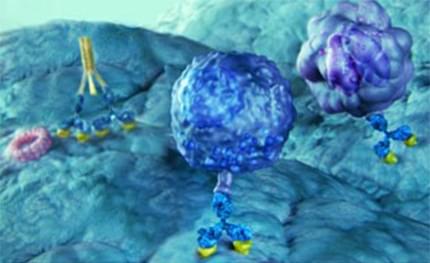
anti-Igκ CAR-T in vivo assay
Antibody or immunoglobulin (Ig) is typically composed of two light chains and two heave chains. In human and other mammals, there are two classes of light chains, namely kappa (κ) chain and lambda (λ) chain. Once set, each B lymphocyte can express only one type of light chains. Antibody is the secreted form of the B cell receptor. Thus, B cells, as well as B cell malignancies, express either κ chain or λ chain on cell surface. Taking advantage of this clonal restriction characteristic, scientists intend to target the κ chain positive lymphoma cells with the normal B cells that express the reciprocal λ chain not affected. The impairment to humoral immunity is therefore minimized. While targeting pan-B cell markers (such as anti-CD19 CAR-T therapy) usually causes depletion of normal B cells and results in severe hypogammaglobulinemia.
Anti-Igκ CAR-T Cell Therapy
It was reported that anti-Igκ CAR-T cells showed cytotoxic activity against Igκ positive tumor cell lines and primary low-grade lymphoma and chronic lymphocytic leukemia (B-CLL) cells both in vitro and in vivo. Patients with refractory or relapsed CLL and non-Hodgkin lymphoma (NHL) are treated with anti-Igκ CAR-T cells in a phase I trial. These CAR-T cells are well-tolerated without adverse effects. The molecular signals of CAR peak at about 1 to 2 weeks after infusion and remain detectable for at least 6 weeks and up to 9 months. Two of five patients with relapsed NHL entered complete remission and three of three patients with multiple myeloma had stable disease associated with reduction of paraprotein, while two of two patients with CLL both progressed. These data confirm the safety and efficacy of anti-Igκ CAR-T cells therapy.